
On November 17, Replit launched Missions, a feature that sends a team of AI agents after a goal you define, inside a spending cap you set. Replit says one of its own test runs built an internal monitoring tool in two days within a $3,000 budget, according to Replit’s Missions announcement. That’s the vendor’s own number, not an independent audit (The New Stack reported it the same way). Still, it shows a useful shift: AI agent development cost is finally being discussed as a budget line rather than a mystery.
This guide breaks down what a small or mid-sized business actually pays to build and run an AI agent, with a worked example based on published model prices and the hidden costs that sink projects.
AI agent development cost for a small business ranges from roughly $1,500 for a simple no-code agent to well over $50,000 for a custom agent connected to several systems. On top of the build, plan a monthly running cost for model usage, platform fees, maintenance and human review. At low volumes that can be under $100; at high volumes, thousands.
What drives AI agent development cost?
An AI agent is software that takes a goal, decides on the steps and uses your tools (inbox, CRM, calendar, online store) to carry them out, usually with a person approving the risky moves. Our guide to AI agents for business covers the longer definition and common uses. Price comes down to five things:
- Scope of the task. One narrow job (sort inbound leads) costs a fraction of an open-ended one (run my sales follow-up).
- Number of integrations. Every system the agent reads from or writes to needs connecting, permissions and testing.
- Risk level. An agent that emails customers or changes orders needs approval steps, logging and fallbacks. That’s build time.
- Build approach. A no-code platform, custom code, or a mix of both.
- Volume. How many tasks it handles per month sets your running cost.
That’s why the cheapest first project is usually a process that’s already clear and repeatable. If you’re not sure which one to pick, start with our checklist on which business processes to automate first.

How much does it cost to build an AI agent?
Almost every quote you’ll get is hours multiplied by a rate. So instead of repeating vendor price lists, here’s a breakdown you can check yourself. The US Bureau of Labor Statistics puts the median software developer wage at $135,980 a year (May 2025 data), which works out to roughly $65 an hour before benefits. Agencies and freelancers charge more because their rate covers overhead, sales and unbillable time, so the table also shows an assumed outside rate of $150 an hour. Your real quotes will vary.
| Agent type | Example | Typical effort | At $65/hr (in-house wage) | At $150/hr (outside rate, assumed) |
|---|---|---|---|---|
| No-code workflow agent | Reads web-form leads, scores them, drafts a reply for approval | 20–60 hours | $1,300–$3,900 | $3,000–$9,000 |
| Custom single agent | Answers order questions from your store data and hands off to staff | 80–250 hours | $5,200–$16,250 | $12,000–$37,500 |
| Multi-step or multi-agent system | Researches prospects, writes outreach, updates the CRM, reports weekly | 300–800+ hours | $19,500–$52,000+ | $45,000–$120,000+ |
Two notes. First, the hour ranges include scoping and testing, the two lines people try to cut and later regret. Second, the in-house column leaves out benefits, recruiting and management time, and most small businesses don’t have a developer with spare hours anyway. For a firm with fewer than 50 people, the realistic choice is usually a no-code build you manage yourself or an outside partner.
What does it cost to run an AI agent each month?
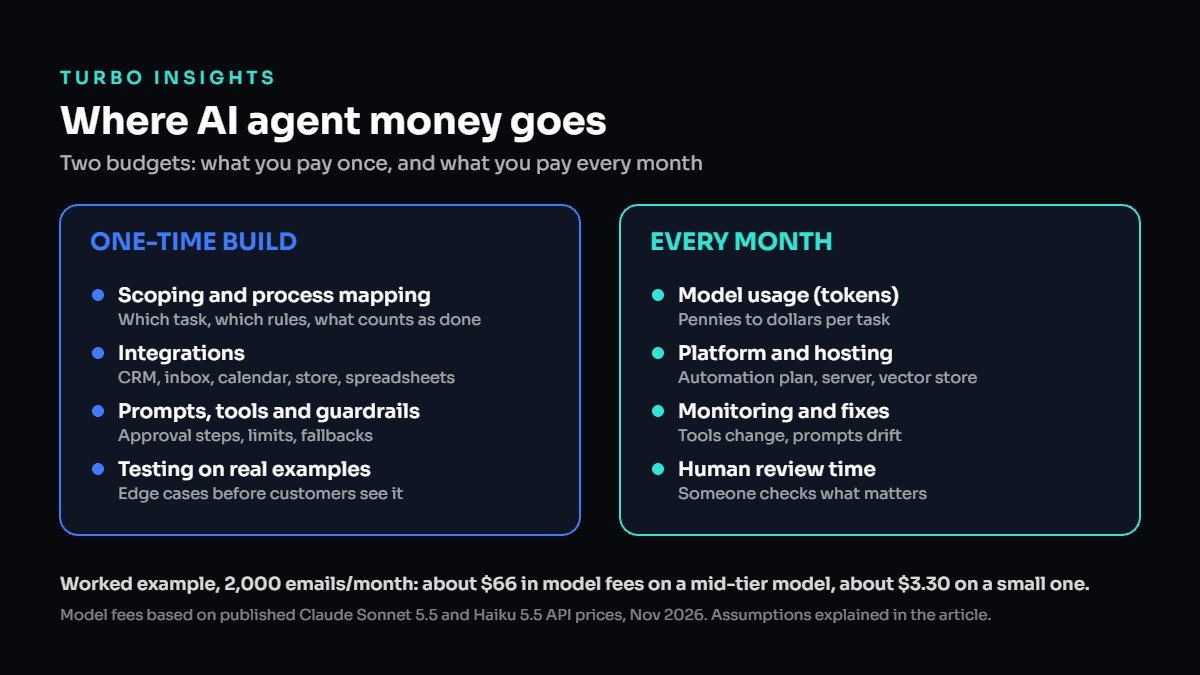
Owners nearly always ask about the build price first. It’s the monthly bill that catches them off guard, and it has four parts:
- Model usage. You pay the AI provider per token, a small chunk of text of roughly three-quarters of a word. Anthropic’s published API pricing lists Claude Sonnet 5.5 at $2 per million input tokens and $10 per million output tokens, and the smaller Haiku 5.5 at $0.10 and $0.50.
- Platform. Automation tools charge a plan fee. n8n’s cloud Starter plan, for example, is listed at €20 a month (billed annually) for 2,500 workflow executions.
- Maintenance. Connected apps change their APIs, prompts drift and your own rules change. Budget a few hours a month.
- Human review. Someone checks the agent’s work, at least for the first months. That’s real payroll.
Worked example: an inbox triage agent
Say a roofing company gets 2,000 emails a month and wants an agent to read each one, sort it (new job, existing customer, supplier, spam) and draft a reply for a person to approve. Assume each email needs three model calls using about 9,000 input tokens and 1,500 output tokens in total, once instructions and context are included.
- On Sonnet 5.5: 9,000 × $2 per million = $0.018 for input, plus 1,500 × $10 per million = $0.015 for output. That’s about $0.033 per email, or roughly $66 a month.
- On Haiku 5.5: 9,000 × $0.10 per million = $0.0009, plus 1,500 × $0.50 per million = $0.00075. That’s about $0.0017 per email, or roughly $3.30 a month.
At small-business volume, the model is rarely the expensive part. The platform plan, the hours to keep it working and the person approving drafts cost more. The practical move is to test on the smaller model first and only step up when it gets things wrong on your real emails.
What hidden costs push AI agent projects over budget?
In June 2025, Gartner predicted that over 40% of agentic AI projects will be canceled by the end of 2027, pointing to escalating costs, unclear business value and inadequate risk controls. Those reasons map closely to where small-business budgets leak:
- Messy data. If your CRM is full of duplicates and half-filled records, the agent inherits the mess. Cleaning it is often the first invoice.
- Vague success criteria. “Make sales faster” can’t be tested. “Reply to every web lead within five minutes with a correct price range” can.
- Guardrails added late. Bolting on approval steps after a mistake costs more than designing them in.
- Runaway usage. Agents that loop or retry burn tokens. Set spending limits at the provider and platform level from day one.
- No owner. Large vendors are building governance in. At Ignite on November 17, Microsoft said agents connected to Agent 365 get their own Entra Agent ID, with cost tools for spending limits and alerts. A small business needs the same idea on a smaller scale: one named person who owns the agent, knows what it can touch and watches what it costs.
Should you build a custom AI agent or use an off-the-shelf tool?
For most small businesses, start with an off-the-shelf tool or a no-code build, not a custom agent. You’ll learn what the job really needs for a few hundred dollars instead of tens of thousands. Most small firms are still early with AI (see our look at small business AI adoption in 2026), which is another reason to begin with one contained project. Go custom when:
- The task touches several of your systems and no product connects them the way you work.
- Volume is high enough that per-seat or per-conversation pricing gets expensive.
- You need control over data handling, logging or approval rules that packaged tools don’t offer.
And when shouldn’t you build an agent at all? If the process follows fixed rules with no judgment involved, plain automation is cheaper and more reliable. Our comparison of AI agents vs chatbots explains where each one fits.

How do you get an accurate AI agent development quote?
Good quotes come from good briefs. Before you talk to anyone, write down:
- The one task, start to finish, including who does it today and how long it takes.
- The systems involved and whether they have APIs (most CRMs, help desks and online stores do).
- What the agent may do on its own and what needs a person’s approval.
- Monthly volume: emails, leads, orders or tickets.
- How you’ll measure success in the first 90 days.
Then ask every vendor for two numbers, separately: the build price and the expected monthly running cost. A partner who only quotes the build hasn’t thought about your second month. Our explainer on what an AI automation agency does lists more questions worth asking. If you’d rather have it scoped and built for you, Turbo Technologies offers AI agent development services, from planning a first agent to multi-agent systems where your team approves what matters.
From the founder. I’ve built and managed WordPress websites and e-commerce stores for years, and AI agents follow the same pattern I saw there: the build is a one-time cost, but the owner’s real bill is everything after launch. I work with AI tools every day, and my rule is simple. Don’t approve any agent until you know two things: its cost per task each month, and who checks its work. If nobody can answer both, the project isn’t ready yet.
Mussadiq Shahbaz, founder of Turbo Technologies
Key takeaways
- AI agent development cost runs from roughly $1,500 for a simple no-code agent to well over $50,000 for a custom, multi-system build.
- Most quotes are hours times a rate; scoping and testing are the lines not to cut.
- Monthly running costs have four parts: model usage, platform, maintenance and human review.
- At small-business volume, model fees are often the smallest line: about $3 to $66 a month for 2,000 emails in our example.
- Start narrow, test on a smaller model and set spending limits from day one.
Want a realistic number for your own process? Tell us about the task and we’ll help you work out what it would take to build and run.
Frequently asked questions
How much does a simple AI agent cost?
A simple agent built on a no-code platform, such as one that sorts web leads and drafts replies for approval, typically takes 20 to 60 hours to set up. At in-house wage rates that is roughly $1,300 to $3,900, and more with an outside partner. Add a monthly platform fee and model usage, which can stay well under $100 at small-business volumes.
What is the monthly cost of running an AI agent?
Running costs have four parts: model usage billed per token, the platform or hosting plan, a few hours of maintenance, and the time someone spends reviewing the agent’s work. In our 2,000-email example, model fees came to about $3.30 a month on a small model and $66 on a mid-tier one. Maintenance and review usually cost more than the model itself.
Why do AI agent projects go over budget?
The usual causes are unclear success criteria, messy data, guardrails added too late and usage nobody capped. Gartner expects over 40% of agentic AI projects to be canceled by the end of 2027, citing escalating costs, unclear business value and weak risk controls. A narrow first project with a measurable goal and spending limits avoids most of these problems.
Is it cheaper to build an AI agent in-house?
Only if you already have a developer with spare time. The BLS median software developer wage is $135,980 a year, before benefits, recruiting and management time. Most small businesses don’t have that capacity, so the realistic options are a no-code build you manage yourself or an outside partner who quotes both the build and the monthly running cost.
How long does it take to build an AI agent?
In our planning estimates, a narrow no-code agent can be live in one to three weeks, including testing. A custom agent connected to several systems usually takes one to three months, and multi-agent systems take longer. Most of the time goes into scoping, connecting systems and testing on real examples, not into writing prompts.